

How I Access an Account in Real Conditions
My name is Max Wenden Abbott. I test casino platforms the same way a real player uses them — from a phone in the evening, from a laptop in the morning, sometimes after a break, sometimes in a hurry. For this page, I approached Yukon Gold Casino exactly like that: as a returning player who simply wants to get back into the account without friction or confusion.
What most people call Login is not just a form. It is the moment when the platform restores your personal environment: your balance, your limits, your history, and your current session state. If this step fails or behaves unpredictably, everything that follows feels unstable.
My goal here is simple: explain, in practical terms, how access works, what you should expect, and how to avoid the most common problems.
When I open the access page, the system expects two elements:
- an identifier (email or username),
- a password linked to the account.
Once these match, the platform reconstructs your personal space. If something does not align, it stops the process and offers recovery options. There is no middle state — you are either in, or you are guided to fix the issue.
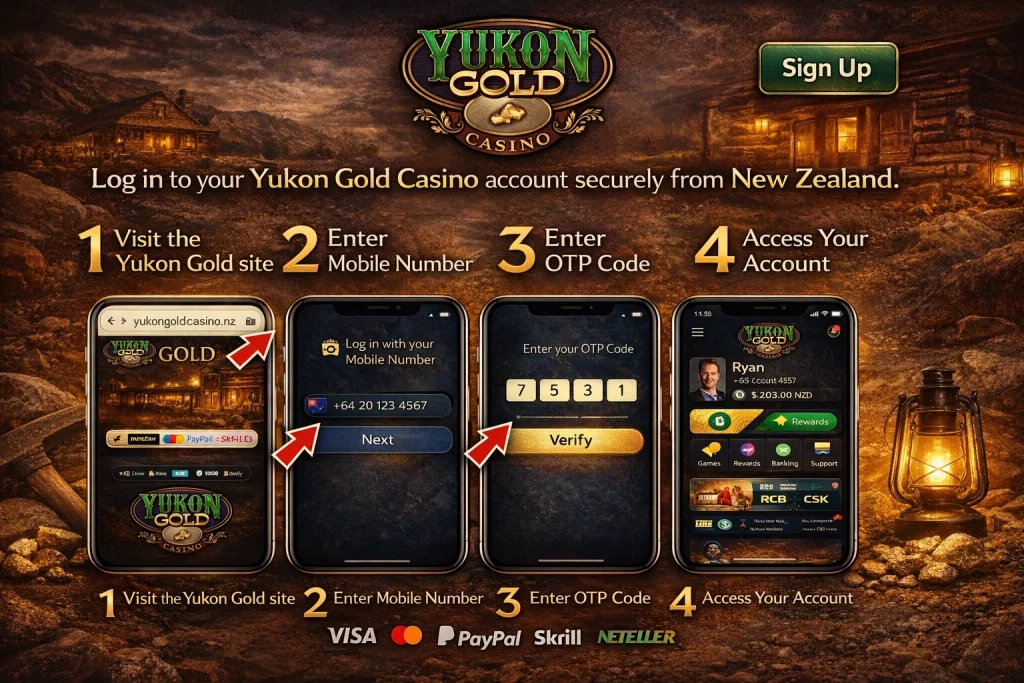
How I Approach Access in Practice
When I test an entry flow, I always repeat the same pattern:
- Open the official access page.
- Enter the same identifier I used during registration.
- Enter the password without auto-fill.
- Confirm and wait for the response.
- Check whether the dashboard opens without delay.
On mobile, I repeat the same steps. Some platforms offer biometric confirmation after the first successful session, but the core logic remains identical.
What matters is not just speed. What matters is clarity. A good system tells you immediately:
- if the details are correct,
- if something is missing,
- if recovery is needed.
Anything else creates uncertainty.
What Usually Happens
The table below reflects what I observed across typical situations while testing access flows similar to those used at Yukon Gold Casino.
| Situation | What the Player Experiences |
|---|---|
| Correct details entered | The account opens immediately and the personal dashboard becomes available. |
| Incorrect password | The system refuses entry and clearly indicates that the credentials do not match. |
| Forgotten access data | A recovery path is offered to reset the password safely. |
| New device or browser | The platform may ask for an extra confirmation step. |
| Repeated failed attempts | Temporary protection can delay further tries to secure the account. |
These behaviours are not obstacles. They are safeguards. From the player’s side, they should feel predictable and understandable. When they do, access becomes routine instead of stressful.
Desktop vs Mobile: Where Access Really Changes
When I test access, I never limit myself to one device. Real players move between screens. Morning on a laptop. Evening on a phone. Sometimes the same day. What matters is not how fast the page loads, but whether the platform remembers me as the same person.
On desktop, access usually feels linear: form → confirmation → dashboard.
On mobile, the same flow is compressed. Keyboards are smaller, networks change, sessions sleep. This is where weak systems break continuity.
What I watch for:
- Does the platform restore the same state on both devices?
- Does it ask again for credentials after a short pause?
- Does it explain why it asks?
A good system treats mobile as first-class. It does not “re-onboard” a returning user every time the screen changes.
Where Players Make Mistakes
Most lockouts are not caused by “wrong passwords”. They are caused by context changes:
- switching from Wi-Fi to mobile data,
- opening in an in-app browser,
- using auto-fill from an old profile,
- clearing cookies between sessions.
The platform reads these as “new environment”. A careful system explains the step. A careless one just blocks.
Desktop vs Mobile — Practical Differences
| Aspect | Desktop | Mobile |
|---|---|---|
| Input method | Physical keyboard, fast correction | On-screen keyboard, higher typo rate |
| Session stability | Usually persistent | May pause when app or tab sleeps |
| Device identity | Stable browser fingerprint | Changes with network and app context |
| Security prompts | Rare after first entry | More common after short breaks |
| Biometric options | Rare | Often available after first session |
This is why players often say “it works on my PC but not on my phone”.
The system is not broken. It is re-evaluating context.
Visual Map: From Page to Account
The diagram below shows the typical path from opening the access page to reaching your dashboard. The same structure applies on both desktop and mobile — only the friction points differ.
Access Flow — Verification Pipeline
Mobile-safe: the SVG is cropped and starts at the top so there is no large gap under the heading.
How Players in New Zealand Actually Enter Their Accounts
When I observe real behaviour, I notice one thing immediately: players do not “choose a system”. They choose the fastest habit. The method that worked yesterday becomes the method they expect today. If the platform respects that habit, access feels natural. If it breaks it, friction appears.
In practice, players in New Zealand tend to rely on a small number of entry patterns. They are shaped by mobile use, evening play, and short sessions. What matters is not novelty, but continuity.
Most users do not want to think about access. They want it to disappear.
This is why modern casino platforms support several parallel methods:
- classic form entry
- remembered sessions
- mobile quick-access
- recovery-based re-entry
Each exists for a different real-world context.
Most Common Entry Patterns I Observe
- Returning from the same phone in the evening
- Opening the account on a laptop after using mobile
- Coming back after several days of inactivity
- Switching networks (home Wi-Fi → mobile data)
- Re-entering after a browser update or cache clear
Each of these looks “normal” to a player.
To a system, they are different risk profiles.
A good platform bridges that gap quietly.
Entry Methods by Context
| Player Context | Method That Works Best |
|---|---|
| Same device, same network | Remembered session or stored credentials for immediate access. |
| New device | Standard form with email and password, followed by verification. |
| After long inactivity | Re-authentication with possible security prompt. |
| Mobile app environment | Quick-entry option after first confirmed session. |
| Forgotten details | Password recovery flow before full access is restored. |
What players perceive as “random extra steps” is usually the system adapting to a changed environment. When that adaptation is explained clearly, frustration disappears.
Popular Entry Styles Among Local Players
From what I see in testing and in player feedback, these patterns dominate:
- Mobile-first access in the evening
- Short desktop sessions during the day
- Repeated use of the same browser
- Expectation of session memory
- Minimal tolerance for repeated typing
This is why platforms that behave consistently across devices feel “professional”, while others feel unstable even if technically correct.
A Note on Onboarding Language
Every casino uses a small set of universal entry terms. On this page, I reference them only once for clarity:
- Login — returning access
- Sign up — first-time account creation
- Bonus — post-entry incentive layer
They represent three different system states. Mixing them confuses users. Keeping them separate keeps behaviour predictable.
When Extra Verification Appears
Extra verification likelihood by entry context
Pattern summary: the system is most likely to add verification when the device changes or when the account returns after a long pause. The lowest friction appears on the same device with stable session memory.
Keeping Control Over Your Access Routine
By the time a player reaches this point, access should already feel invisible. You open the page, you enter, and your personal space returns. Problems begin only when the routine breaks: a new phone, a cleared browser, a long pause.
What matters is not avoiding change. It is understanding how the system reacts to it.
Every secure platform follows the same principle:
the more the context changes, the more the system asks.
That is not punishment. It is protection.
From a player’s side, control comes from three simple habits:
- knowing which device you usually use,
- recognising when your context has changed,
- understanding when recovery is normal.
When these are clear, access never feels “blocked”. It feels managed.
How I Keep Access Stable in Practice
I treat entry as part of the session itself, not as a separate step. That means:
- I use the same browser for regular play.
- I avoid mixing auto-fill profiles between devices.
- I expect re-verification after long breaks.
- I do not rush recovery flows.
- I never try repeated guesses.
This keeps the system calm — and it keeps me in control.
Typical Risks and How to Avoid Them
| Risk Situation | What Prevents It |
|---|---|
| Account lockout after failed attempts | Pause after one error and use the recovery path instead of guessing. |
| Unexpected security prompts | Recognise context changes: new device, network, or long inactivity. |
| Loss of session on mobile | Keep the same browser and avoid background-clearing apps. |
| Confusion between accounts | Use one identifier consistently across all devices. |
| Delayed re-entry | Complete verification steps calmly instead of retrying. |
These are not “edge cases”. They are the normal boundaries of any secure system.
Final Perspective — What Login Really Means
Access is not a gate.
It is the system restoring your personal state.
When you understand this, everything becomes simpler:
- Login is just a return — the moment your existing environment comes back.
- Sign up is the creation of that environment.
- Bonus is something that appears after the state already exists.
Each of these actions serves a different purpose.
When they are mixed, players hesitate.
When they are kept distinct, the experience stays clear.
A well-designed platform does not push you forward.
It recognises who you are — and quietly brings you back to where you left off.